
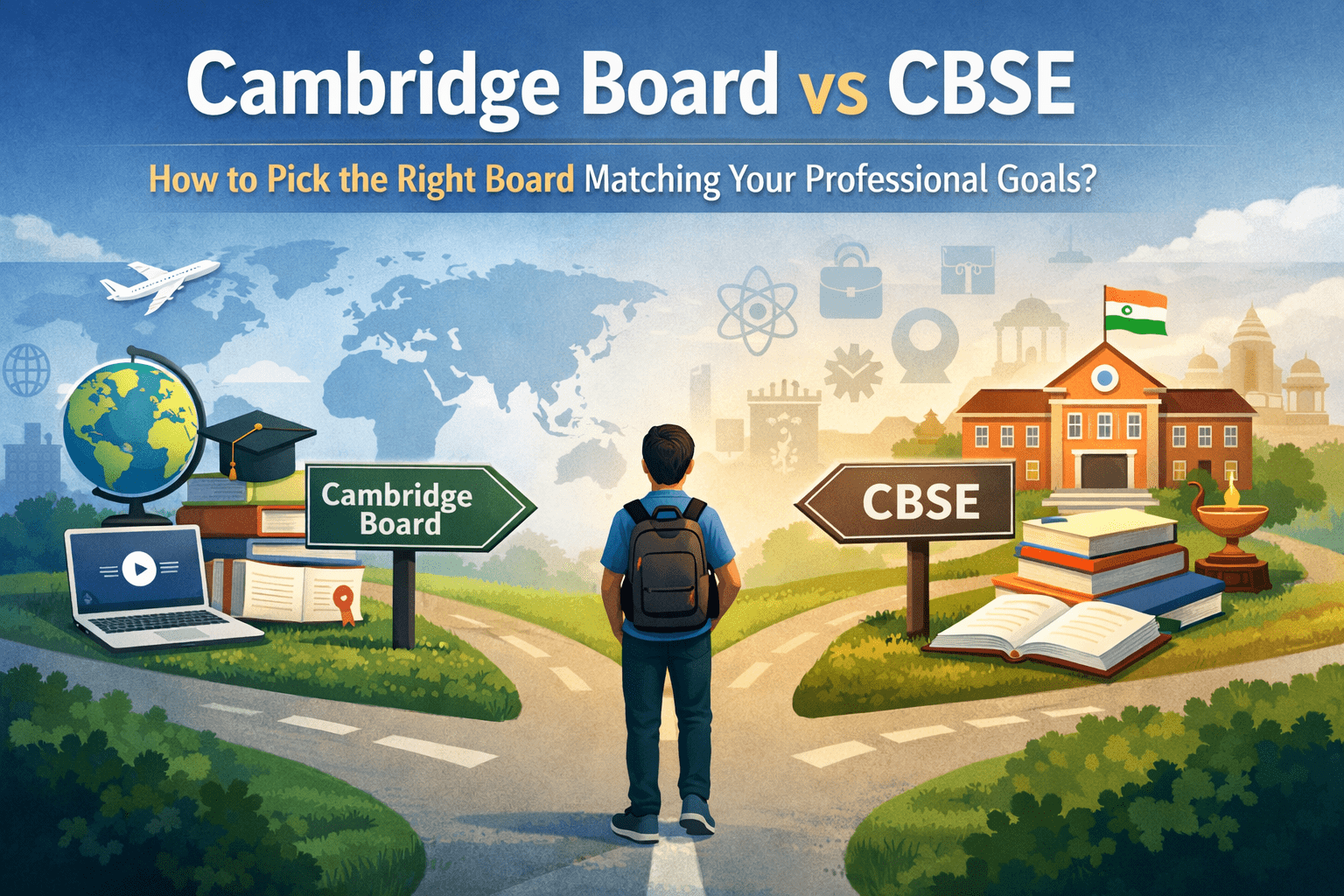
Selecting an ideal education board is integral to a child’s development, so it is one of the most critical decisions parents usually make. With reference to India, two prominent boards that run are CBSE (short for Central Board of Secondary Education) and CAIE (short for Cambridge Assessment International Education). Now, the question is, is the Cambridge board better than CBSE? And if so, then why?
Widely recognized across India and centrally managed, CBSE is known for offering practical and vocational-focused education. The CBSE curriculum is made flexible and adaptable, offering a wide array of subjects such as mathematics, vocational studies, science, social science, and languages. However, when it comes to the Cambridge curriculum vs the CBSE curriculum, the former is developed by the CAIE (Cambridge Assessment International Education). Cambridge allows students to choose from many subjects. In the Cambridge curriculum, students may choose up to 14 subjects or at least 5.
The core subjects in this curriculum are science, math, and English. With options like technology, arts, and social sciences, it provides a flexible, global learning experience. Now, let us begin by decoding the key differences between the IGCSE and CBSE boards.
The distinct roles and functions of CBSE and Cambridge set the two boards apart. CBSE designs the curriculum for secondary and senior secondary education in India. This board is responsible for overseeing two key exams: the All-India Senior School Certificate Examination (AISSCE) and the All-India Secondary School Examination (AISSE). Recognised by the National Council of Educational Research and Training (NCERT), CBSE aims to build a vast network of central schools to offer a gamut of transferable job opportunities for government employees. Besides, the CBSE syllabus is designed to help students prepare for national-level entrance exams.
On the contrary, the CAIE programme is affiliated with the University of Cambridge and is recognized worldwide. This programme offers the global learning community and emphasizes the development and refinement of practical and intellectual skills. The Cambridge board is ideal for students who intend to study and work abroad with a sharp focus on problem-solving and creative thinking.
Also read - NCERT vs CBSE
When comparing the two boards, their curricula stand out as a major difference. Cambridge promotes practical, flexible learning with IGCSE, allowing students to choose subjects based on their interests and future plans. After IGCSE, students can advance to A Levels, where they focus on a few key subjects for deeper, specialized study. This educational level underscores analytical skills, critical thinking, and a deep understanding of subjects the learner has picked, setting them up for success at university and beyond.
CBSE, however, administers a standardized curriculum created to support holistic education. This structure promotes balanced growth through varied subjects. In Grade 10, learners follow the SSC syllabus, centered around Science, Maths, and Social Science, with other school-selected subjects included. The prime aim is that a board-based education well prepares learners for further pursuits and competitive exams. In grade 12, the students switch to the higher secondary curriculum, where the main emphasis is on core subjects such as Mathematics and Science for students who wish to pursue the medical or engineering fields. It even offers streams in Commerce and Humanities.
CBSE uses internal assessments and practical’s that align with annual board exams for grades 10 and 12. The Cambridge assessments majorly follow a hands-on approach to teaching as well as learning. Main difference is that here, emphasis is on imparting strong conceptual understanding.
It is extremely essential to understand that while CBSE carries nationwide recognition, Cambridge is renowned worldwide for its global benchmarks.
CBSE comes with a well-structured curriculum ideal for studies and competitive exams in India. Cambridge brings a more flexible and globally-recognized approach, which is perfect for learners wanting international exposure. Hence, it makes sense to fetch precise details on the differences between ICSE & CBSE.
CBSE definitely is perfect for children aiming to sit for Indian competitive exams following a standardized learning path. Cambridge offers flexible, globally recognized learning for those seeking international opportunities.
Cambridge brings a more practical, flexible, and globally recognized curriculum, while CBSE board relies on a more structured, template-based and India-specific approach suited for core subjects and exams. Cambridge mainly follows an English-only approach, while CBSE allows students to learn in English, Hindi, or other regional languages.
Cambridge board offers a more flexible, and globally recognized curriculum. Those willing to pursue a career in India, must opt for CBSE.
TKC World School follows a highly flexible, and integrated curriculum supporting each learner, whether pursuing CBSE or IGCSE.





Share This News